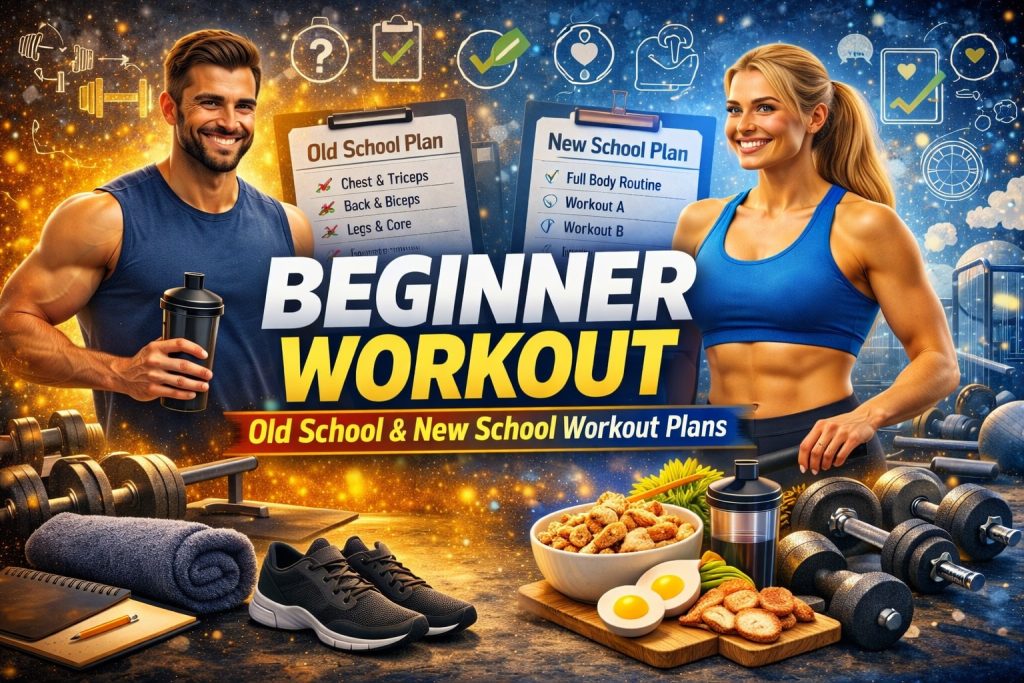

Starting a beginner workout routine can feel strange at first.
You watch fitness videos.
People lift heavy weights.
Everyone seems to know what they are doing.
And you stand there thinking…
Where do I even start?
I remember the first week I walked into a gym. I spent almost 15 minutes just looking around. Machines everywhere. Dumbbells everywhere. Everyone looked busy.
Honestly, I almost left.
If you feel something similar, you are not alone.
This guide is simple. No complicated science. No confusing routines.
Just a clear path for your first few months of training.
Why a Beginner Workout Plan Matters
Many beginners do something random.
One day chest.
Next day arms.
Then maybe treadmill for 20 minutes.
After a few weeks they stop.
Not because they are lazy.
Because they had no plan.
A structured beginner workout helps you:
• learn correct movement patterns
• build strength safely
• avoid injuries
• stay consistent
• see progress faster
Without a plan, the gym becomes guessing.
With a plan, things start making sense.
What Actually Happens When Beginners Start Training
Your body reacts quickly during the first few months.
That phase is often called newbie gains.
You may notice:
• muscles feel tighter
• strength increases every week
• energy improves
• posture gets better
It feels motivating.
But here is something beginners often miss.
Your goal at this stage is learning movements, not lifting heavy.
If you rush into heavy lifting too early, you will struggle with form.
And bad form becomes a habit.
The Core Movements Every Beginner Should Learn
Instead of random exercises, focus on basic patterns.
These movements build your base.
Push Movements
Examples:
• push ups
• bench press
• shoulder press
These train chest, shoulders, and triceps.
Pull Movements
Examples:
• pull ups
• lat pulldown
• rows
These train your back and biceps.
Leg Movements
Examples:
• squats
• lunges
• leg press
Your legs contain the largest muscles in your body.
Training them helps overall strength.
Core Stability
Examples:
• planks
• hanging leg raises
• crunches
Your core supports every other movement.
Ignore it and your lifts will suffer.
Beginner Workout Frequency
You do not need to train every day.
Actually, many beginners train too much.
Three to four days per week is enough.
Something like this works well:
• Monday – Workout
• Tuesday – Rest
• Wednesday – Workout
• Thursday – Rest
• Friday – Workout
• Weekend – Light activity
This schedule gives your muscles time to recover.
Recovery is when growth happens.
Old School Workout Plan for Beginner
Some people prefer simple routines.
No complicated splits. No endless variations.
Just basic exercises done consistently.
This is where the old school workout plan for beginner comes in.
Old school training focuses on:
• compound lifts
• basic movements
• progressive overload
• consistency
Let me show you a simple version.
Day 1 – Chest and Triceps
Exercises:
• Bench Press – 4 sets
• Incline Dumbbell Press – 3 sets
• Push Ups – 3 sets
• Tricep Dips – 3 sets
• Rope Pushdown – 3 sets
Keep rest around 60–90 seconds.
Focus on controlled movement.
Day 2 – Back and Biceps
Exercises:
• Lat Pulldown – 4 sets
• Seated Row – 3 sets
• Dumbbell Row – 3 sets
• Barbell Curl – 3 sets
• Hammer Curl – 3 sets
Slow reps work better than swinging the weight.
Day 3 – Legs and Core
Exercises:
• Squats – 4 sets
• Leg Press – 3 sets
• Walking Lunges – 3 sets
• Leg Curl – 3 sets
• Plank – 3 rounds
Leg training feels tough at first.
But skipping leg day creates imbalance.
Why Old School Training Still Works
You might wonder.
Why follow an old school workout plan for beginner when modern programs exist?
Simple answer.
It works.
Old routines built many strong athletes before social media existed.
They focused on:
• progressive overload
• discipline
• simple structure
Sometimes simple methods work best.
New School Workout Plan for Beginner
Fitness training has changed over time.
Now we see more structured and balanced routines.
The new school workout plan for beginner usually focuses on:
• movement quality
• full body training
• injury prevention
• balanced strength
Many beginners find this approach easier.
Full Body Beginner Routine
Train three days per week.
Each session hits the whole body.
Example plan:
Workout A
• Squats – 3 sets
• Bench Press – 3 sets
• Lat Pulldown – 3 sets
• Shoulder Press – 3 sets
• Plank – 3 rounds
Workout B
• Deadlift – 3 sets
• Incline Dumbbell Press – 3 sets
• Seated Row – 3 sets
• Lateral Raises – 3 sets
• Leg Raises – 3 sets
Alternate workouts.
Week example:
• Monday – Workout A
• Wednesday – Workout B
• Friday – Workout A
Next week switch order.
Old School vs New School Beginner Workout
People often ask which one is better.
Truth?
Both can work.
The difference mostly comes down to preference.
Old school style:
• body part splits
• more volume per muscle
• classic bodybuilding style
New school style:
• full body training
• balanced frequency
• shorter workouts
If you enjoy longer gym sessions, you may like old school routines.
If you prefer shorter sessions, new school training works well.
How Much Weight Should Beginners Lift?
This question comes up a lot.
Beginners often try to lift heavy immediately.
That usually leads to poor form.
Instead:
Start with a weight you can control for 10–12 reps.
Ask yourself during a set:
Can I keep my form clean?
If the answer is no, reduce the weight.
Strength will come later.
Movement quality comes first.
Beginner Workout Mistakes I See All the Time
After years of training, certain mistakes appear again and again.
Maybe you have seen them too.
1. Skipping Warmups
Jumping straight into heavy lifts is risky.
Spend 5–10 minutes warming up.
Simple options:
• treadmill walk
• light cycling
• dynamic stretching
Your joints will thank you.
2. Ego Lifting
This happens a lot.
Someone loads heavy weight to impress others.
The result?
Bad form.
Training is not a competition.
Focus on steady progress.
3. Ignoring Recovery
Muscles grow during recovery.
Not during the workout.
Make sure you get:
• proper sleep
• enough protein
• rest days
Without recovery, progress slows down.
4. Doing Too Many Exercises
Beginners sometimes copy advanced routines.
Ten exercises per workout.
That is unnecessary.
Four to six exercises are enough.
Nutrition for Beginner Workouts
Training alone will not give results.
Food matters just as much.
You do not need complicated diets.
Start with simple habits.
Eat Enough Protein
Protein supports muscle repair.
Good sources include:
• eggs
• chicken
• paneer
• lentils
• tofu
A basic guideline is 1.6 to 2 grams per kg bodyweight.
Do Not Fear Carbs
Carbohydrates provide energy.
Examples:
• rice
• oats
• potatoes
• fruits
Low energy leads to weak workouts.
Drink Enough Water
Hydration affects performance.
Even mild dehydration reduces strength.
Carry a water bottle in the gym.
Tracking Your Progress
One small habit makes a huge difference.
Track your workouts.
Write down:
• exercises
• weights used
• number of reps
This helps you see progress.
For example:
Week 1 – Squat 40 kg
Week 3 – Squat 50 kg
That progress keeps motivation high.
Building Consistency With Beginner Workouts
Here is something people rarely talk about.
Motivation fades.
It always does.
The real key is routine.
Try this approach:
• train at the same time each day
• prepare gym clothes in advance
• keep workouts simple
When something becomes a habit, you stop debating whether to go.
You just go.
The EEAT Principle and Why It Matters in Fitness Advice
You might notice many websites sharing workout advice.
Some of it is helpful.
Some of it is random.
Google evaluates fitness content using EEAT:
Experience
Expertise
Authoritativeness
Trustworthiness
In simple terms, it asks:
Does the writer have real experience?
Is the advice practical?
Can readers trust the information?
In this guide, the focus stayed on real training principles used in gyms worldwide.
Basic movements.
Structured routines.
Gradual progress.
Nothing fancy.
Because beginners do not need fancy.
How Long Before You See Results?
Most beginners notice changes within 6–8 weeks.
Strength improves first.
Then muscle definition appears slowly.
But results depend on three things:
• training consistency
• nutrition
• recovery
Miss one of these and progress slows.
Stay patient.
Your body needs time to adapt.
A Simple Beginner Workout Checklist
Before starting your training week, check these points.
• Do you have a workout plan?
• Are you tracking your lifts?
• Are you sleeping enough?
• Are you eating enough protein?
• Are you training consistently?
If most answers are yes, you are on the right path.
Final Thoughts on Starting a Beginner Workout
Starting a beginner workout does not need to feel complicated.
You do not need perfect knowledge.
You just need a plan.
Old school training works.
New school training works.
What matters most is showing up.
Three workouts this week.
Three workouts next week.
Then months pass.
Strength grows.
Confidence grows.
And one day you walk into the gym without hesitation.
Funny how that happens.
You remember the first day you felt lost.
Now someone else is standing there looking confused.
And maybe you help them start their first workout too.